

This is Part 5 in our series on customer journey optimization. "Originally from our LinkedIn here" If you haven't read Part 1: Rethinking Customer Journeys, start there to understand the full Connect, Understand, Engage, Guide framework.
In This Series:
You have connected your systems, learned to read behavioral signals, and built personalized experiences that respond to who your visitors are and where they are in their journey. The first four pillars of this framework have been building toward something. This final pillar is where it all comes together.
Guide is about more than directing people to a next step. It is about creating the kind of clarity, momentum, and shared visibility that allows people to move confidently through complex decisions without feeling lost, overwhelmed, or left to figure things out alone.
In many ways, Guide is the most human of the four pillars. Connect, Understand, and Engage are largely driven by data and technology. Guide is about experience design, empathy, and a genuine commitment to helping people succeed, not just converting them to a customer.
There is a temptation in digital experience design to focus almost entirely on the top of the funnel. Driving traffic, generating leads, optimizing sales conversion. Those things matter, but they ignore a significant truth: for most organizations, the journey does not end at a conversion. It often gets more complex from there.
Think about what happens after someone signs a contract, submits an enrolment form, or makes a significant purchase. There is onboarding to complete. There are multiple people who may need to get up to speed. There are decisions within decisions, approvals to gather, documents to exchange, and milestones to track. For business-to-business relationships in particular, the post-sale journey can span weeks or months and involve stakeholders across procurement, legal, finance, and operations, many of whom were never part of the original conversation.
When organizations fail to guide people through this complexity, the results are predictable. Delays accumulate. Momentum stalls. Customers lose confidence. What should have been an exciting new relationship starts to feel like hard work.
Guide is the difference between a customer who feels like they are navigating a maze alone and one who feels like they have a knowledgeable partner walking with them every step of the way.
The good news is that getting Guide right does not require reinventing your business processes. It requires being intentional about clarity, continuity, and shared visibility across the journey.
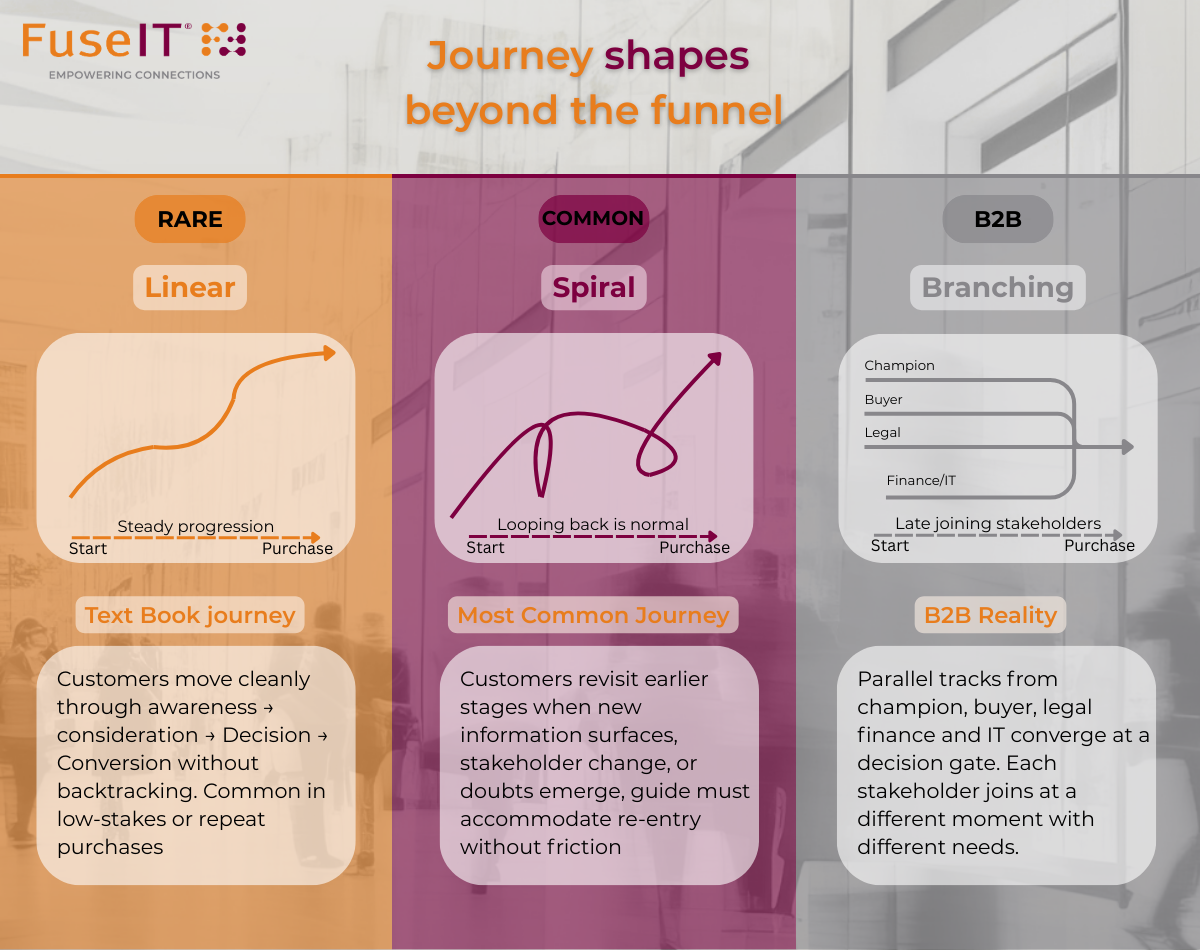
Many organizations design their customer journeys as if they are linear. Step one leads to step two, which leads to step three. Handbooks, onboarding checklists, and project plans all tend to reflect this mental model. And while structure is valuable, reality is rarely so tidy.
Customers pause and come back. Stakeholders who were not involved in the original decision suddenly need to be consulted. A new requirement surfaces mid-process that sends people back to an earlier stage. Someone goes on leave, and a colleague needs to pick up where they left off without starting from scratch. Internal approvals take longer than expected. Information that seemed settled turns out to need revisiting.
When journey design assumes linearity, these detours become friction. When it anticipates them, they become manageable. The organizations that do Guide well are the ones that have stopped thinking about the customer journey as a funnel and started thinking about it as a collaborative project with shared ownership, visible progress, and the flexibility to accommodate real-world complexity
At first glance, Guide can appear quite different depending on the type of journey and the relationship between your organization and the customer. But across contexts, a few core practices show up consistently in organizations that do it well.
One of the most powerful tools in a Guide-focused approach is the creation of shared digital spaces where all the relevant information for a particular journey lives in one place. These are sometimes called digital sales rooms, onboarding portals, or customer workspaces. The name matters less than the principle: rather than scattering information across emails, attachments, and multiple systems, you give everyone involved a single place to go.
These spaces can contain curated content relevant to the specific customer, shared documents and contracts, progress trackers, key contacts, and space for questions and comments. A prospect in the final stages of evaluation might have access to a space that includes tailored case studies, a pricing summary relevant to their situation, implementation documentation, and a direct channel to ask questions of their assigned contact. An onboarding customer might have a workspace that tracks which steps have been completed, which are pending, who is responsible for each, and what comes next.
The effect on the customer experience is significant. Instead of needing to chase information or rely on email threads that are hard to search and easy to lose, they have everything they need in one place, accessible whenever it is convenient for them. And importantly, they can see exactly where things stand at any given moment.
In business-to-business contexts (B2B), the person your sales team initially engages with is rarely the only person who matters. Buying decisions typically involve procurement, finance, legal, and sometimes the CEO or board, depending on the size of the investment. Each of these stakeholders has different questions, different concerns, and different criteria for moving forward.
The traditional approach to this reality is to expect your primary customer contact to cascade information internally and report back. This is slow, prone to distortion, and puts an unfair burden on the person you are dealing with directly. A Guide-focused approach creates visibility for everyone who needs it, not just your main point of contact.
When multiple stakeholders can see the same information, ask questions in a shared space, and track progress against the same milestones, the process moves faster and with far fewer misunderstandings.
This is particularly relevant for the stakeholders who tend to appear late in the process. Legal teams reviewing contract terms, finance teams assessing pricing and payment structures, IT teams evaluating security requirements. These people are often asked to assess something quickly, without the context that has been built up over weeks of earlier conversations. Giving them direct access to a curated workspace, with the information they need already organized and visible, dramatically reduces the back-and-forth that so often slows complex deals and onboarding processes to a crawl.
One of the most underappreciated capabilities in a Guide-focused approach is the ability to track who is engaging with shared content, and who is not. Your primary contact may tell you that everyone is aligned and the decision is moving forward. But if your workspace shows you that the legal team has not been sent the contract documentation and the finance lead has not reviewed the pricing summary, you have early warning signs that something may be about to slow down.
This kind of visibility allows your team to be proactive rather than reactive. Instead of waiting for your contact to report back that legal has questions, you can reach out directly with the relevant information before the question becomes a blocker. Instead of discovering at the last moment that a key stakeholder has concerns about implementation, you can surface those concerns earlier when there is still time to address them without derailing the timeline.
It also helps you understand where your content and collateral are actually landing. If you create a detailed security overview document and the IT team spends twenty minutes with it before moving forward, that tells you something valuable about what matters to them. If they never open it, that tells you something too. Over time, this kind of engagement data becomes one of your most useful inputs into improving both your content and your process.
We like to think of static content delivery as a one-way street. That is, it tells the customer something, but it does not create a conversation. One of the most effective ways to reduce friction in complex journeys is to enable interaction directly within a shared workspace, so that questions, clarifications, and approvals can happen in context rather than in disconnected email chains.
When a stakeholder can comment about a proposal or implementation plan, the conversation stays anchored to the relevant content. There is no ambiguity about what is being discussed. There is a clear record of what was asked, when, and how it was answered. And the person responsible for addressing the question gets a notification immediately rather than waiting for an email that might get buried.
This is a small shift in how information is exchanged, but it has a great effect on the pace and quality of complex journeys. It keeps conversations organized, reduces the number of follow-up questions needed to establish context, and creates a shared record that anyone joining the process later can review to get up to speed quickly.
Much of what Guide does is invisible when it is working well. Friction, by contrast, is very visible to the people experiencing it. The extra form they have to fill in with information you already have. The confusion about what happens next. The need to ask the same question twice because the answer got lost in an email thread.
Friction erodes confidence and trust. It signals to the customer that the organization they have chosen to work with is not as organized as they hoped. And in high-stakes decisions, even small amounts of friction can cause people to reconsider.
The work of reducing friction starts with journey mapping from the customer's perspective, not your internal process diagram. What does the experience actually feel like at each stage? Where do people have to work harder than they should? Where do they have to repeat themselves? Where do they lose track of where things stand or what comes next?
Common sources of friction that Guide is specifically designed to address include unclear next steps, particularly at handoff points between teams. When a prospect becomes a customer, the person they have been dealing with in sales often hands off to someone in onboarding or customer success. From the customer's perspective, this transition can feel abrupt. The relationship they built and the context that was established often does not transfer cleanly. A shared workspace that both the sales team and the onboarding team contribute to and can reference means the customer does not have to start over.
Information overload at critical decision points is another major source of friction. When too much information arrives at once, people freeze. Progressive disclosure, surfacing only what is relevant at each stage, keeps people moving without overwhelming them. The art is in knowing what someone needs right now versus what they will need later, and sequencing accordingly.
The inability to pause and resume is a friction point that is often overlooked entirely. Real people have competing priorities. A complex onboarding process that requires completing everything in one sitting, or that loses progress when someone comes back after a break, creates unnecessary barriers. A workspace where someone can pick up exactly where they left off, with clear visibility into what has been done and what remains, removes that barrier entirely.
Guide looks different depending on the type of relationship you are managing, and it is worth addressing both directly.
In business-to-business contexts, the complexity is primarily organizational. Multiple stakeholders, shared accountability, longer timelines, and formal approval processes all create the conditions where Guide has the most visible impact. The collaborative workspace model maps naturally onto these dynamics because it mirrors how complex projects are actually managed within organizations. When you give a B2B customer a space that feels like a project management environment rather than a sales tool, you are meeting them where they already work.
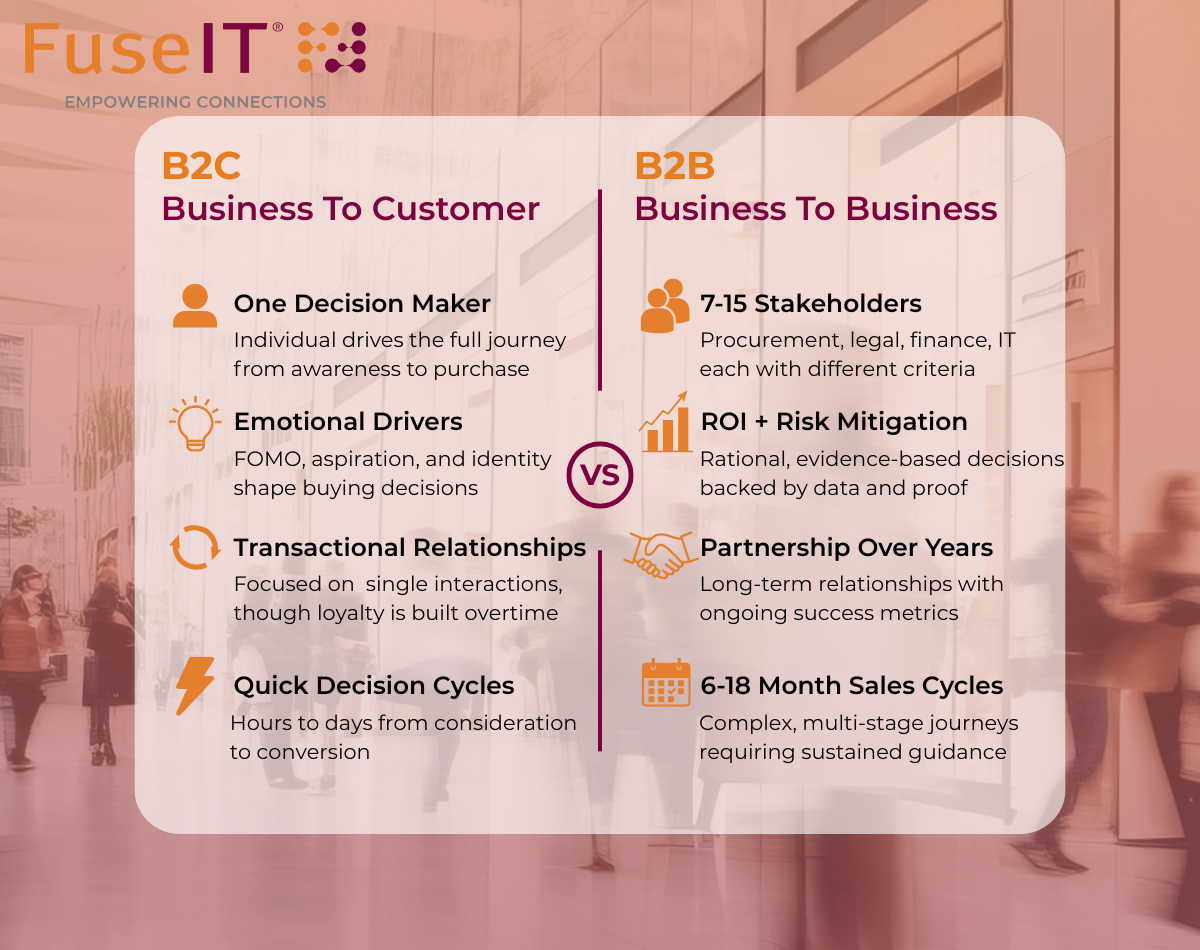
In business-to-consumer contexts, the complexity tends to be more emotional. FOMO, or the fear of missing out, can accelerate decisions. Doubt and uncertainty can stall them. The consumer journey is often shorter but can be just as nonlinear, particularly for high-consideration purchases like financial products, healthcare decisions, or significant personal investments. Guide in these contexts is less about coordinating multiple stakeholders and more about creating confidence. Clear progress indicators, transparent timelines, proactive communication about what happens next, and easy ways to ask questions all serve the same underlying purpose: reducing the anxiety that accompanies significant decisions.
Whether you are working in B2B or B2C, the goal of Guide is the same. Help people feel that they are making progress, that they know what comes next, and that they have the support they need to move forward with confidence.
One of the challenges with Guide is that its impact is sometimes harder to isolate than the impact of, say, a content personalization change or a new lead scoring model. But there are meaningful signals that tell you whether your guidance approach is actually reducing friction and improving outcomes.
Time to completion for key milestones is one of the clearest indicators. If your average onboarding used to take twelve weeks and it now takes eight, something in the experience has improved. If deals that involve four or more stakeholders used to stall regularly at the legal stage and now move through more predictably, your multi-stakeholder workspace is doing its job.
Stakeholder engagement rates within shared workspaces tell you whether the people who matter are actually participating. If your workspace shows that finance contacts are viewing the pricing documentation within two days of being invited, that is a meaningful signal that the approach is working. If they are not engaging at all, that is a signal to investigate.
Customer satisfaction scores at key transition points, particularly the handoff from sales to onboarding, are another useful measure. These transitions are among the highest-risk moments in any customer relationship, and they are where Guide has the most potential to make a difference.
Finally, expansion and renewal rates are worth tracking with Guide in mind. Customers who felt well-supported through a complex journey are significantly more likely to expand their relationship with you and to refer others. The relationship you build through the journey itself is one of the most durable competitive advantages you can create.
So how do you avoid making mistakes? Here are some approaches that can trip organizations up.
Pitfall 1 - Designing for Your Process, Not Their Experience: Internal onboarding checklists and project plans reflect what is convenient for your team, not what is intuitive for the customer.
Solution: Design the customer-facing experience from the outside in. Start with the questions the customer is likely to have at each stage, and build the guidance around answering them.
Pitfall 2 - Too Much Information, Too Soon: Comprehensive documentation that contains absolutely everything a customer might ever need.
Solution: While this is well intentioned, consider how you can simplify information and surface it in stages as it becomes relevant. Start with what someone needs right now. Add context as they progress.
Pitfall 3 - Neglecting the Stakeholders You Haven';t Meet: In complex B2B journeys, it is easy to over-invest in the relationships you have already built and under-invest in the people who will be involved later. Legal, finance, IT, and procurement teams are often brought into a process late
Solution: Designing your workspace and your content strategy to accommodate late-arriving stakeholders, giving them what they need to get up to speed quickly.
Pitfall 4 - Failing to Maintain Momentum: Complex journeys have natural pauses, which are normal but may become indefinite if there is no mechanism for maintaining momentum.
Solution: Automated reminders, milestone notifications, and proactive check-ins from your team keep things moving without putting the full burden of progress on the customer. The goal is to make it easy to restart after a pause, not to pressure people into moving faster than they are ready to.
Pitfall 5 - Focus on Sales Tools Over Customer Tools: Using collaborative workspaces primarily as a way to track customer engagement for the benefit of your sales, rather than as a genuine resource for the customer.
Solution: Look at your workspaces from the customer perspective. Is everything in this workspace genuinely useful to the customer? If the answer is yes, you are on the right track.
Guide is the final pillar of the Connect, Understand, Engage, Guide framework, and in many ways it is the culmination of everything that comes before it. The data you have connected, the signals you have learned to read, the personalized experiences you have created: all of it is in service of a relationship that needs to go somewhere. Guide is what makes sure it gets there.
The organizations that excel at Guide are not necessarily the ones with the most sophisticated technology. They are the ones who have genuinely internalized what it feels like to be a customer navigating a complex journey, and who have made a deliberate commitment to making that experience easier, clearer, and more human.
When Guide is working well, customers do not experience it as being led. They simply feel like they are moving forward with confidence, that they know what comes next, and that the organization they are working with is organized, responsive, and on their side. That feeling is one of the most powerful things any organization can create, and it is entirely within reach.
The best customer journeys do not feel like journeys at all. They feel like good working relationships, where progress is natural, communication is easy, and both sides are moving toward the same outcome together.
This article concludes our five-part series on optimizing customer journeys across online touchpoints. We hope the Connect, Understand, Engage, Guide framework gives you a practical lens for identifying where to focus your efforts and measuring the impact of your improvements.
Questions? Connect with us on LinkedIn or schedule a conversation to discuss your specific Connect challenges.
Has this triggered any questions, and want to keep the conversation flowing? We'd love to talk.



Connecting systems and people since 1992.
A New Zealand–founded global tech company.


By clicking 'Accept all', you agree to the storing of cookies on your device to enhance site navigation, analyze site usage, and assist in our marketing efforts. View our Privacy Policy for more information.
