

This is Part 4 in our series on customer journey optimization. "Originally from our LinkedIn here" If you haven't read Part 1: Rethinking Customer Journeys, start there to understand the full Connect, Understand, Engage, Guide framework.
In This Series:
You have connected your systems. You are reading behavioral signals. You know that someone has visited your pricing page three times, compared your plans side by side, and read a customer story from an organization that looks a lot like theirs.
Now comes the question that the first two pillars were always building toward: how do you apply knowledge?
That is what the Engage pillar is about. Not only sending the right email at the right time, but shaping the actual experience someone has when they land on your website. It is the difference between a digital presence that treats every visitor the same and one that responds, adapts, and feels like it genuinely understands who it is talking to.
But here's the tension: personalization done wrong feels invasive. Done right, it feels intuitive, like the experience was designed just for you.
Today, we're going deep on how to get it right.
When most people hear the word engagement, they think of outbound communication. A follow-up email. A sales call. A triggered campaign. Those things matter, but they are only part of the picture.
In this model, Engage means something broader. It refers to every interaction a person has with your organization across digital touchpoints, and specifically, whether those interactions feel coherent, contextual, and relevant to them as an individual. That encompasses the content shown on your website when they arrive, the navigation paths that are highlighted, the calls to action that appear, the messages that surface at just the right moment, and the experiences that quietly adapt based on what you already know.
The reason this matters is straightforward. People have limited patience for irrelevance. When someone returns to your website as an existing customer and is greeted with a prompt to request a demo for a product they already own, the experience signals a lack of awareness that erodes trust. When a prospect who has spent three sessions researching your enterprise offering is shown content aimed at small business owners, you are wasting the context you have already earned.
Engage is where all the work of Connect and Understand either pays off or quietly falls apart.
Before we get into how to build effective engagement, it is worth spending time on the tension that sits right at the heart of it.
People want personalized experiences. Research consistently shows that customers respond better to content that feels relevant to them, are more likely to engage when messaging reflects their context, and are increasingly frustrated by generic interactions that ignore what an organization already knows. At the same time, people are deeply wary of how their data is being used. Privacy concerns have grown significantly over the past decade, and consumers have become more sophisticated about recognizing when personalization crosses a line into something that feels intrusive.
This tension is sometimes called the personalization paradox. Most people are what you might call data pragmatists. They will share information, and they will accept that organizations use it, but only when the value they receive in return is proportionate to what they have given up. When personalization saves them time, removes friction, or makes a complex decision easier to navigate, they welcome it. When it feels like they are being watched, profiled, or manipulated, they disengage, and, may not return.
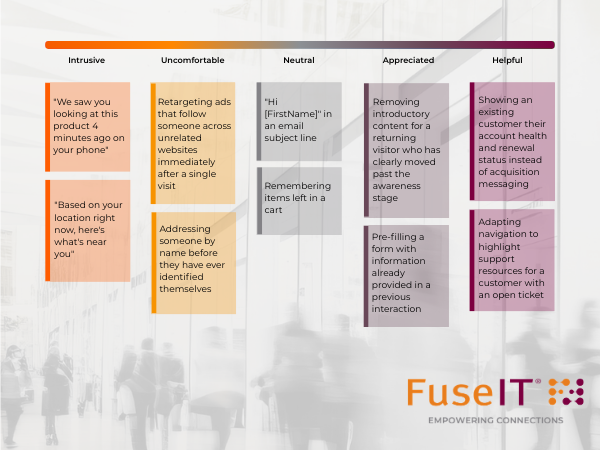
The practical implication is that effective engagement always needs to pass a simple test: does this feel helpful to the person receiving it, or does it feel like it is serving the organization at the person's expense?
A website that surfaces your name prominently on every page is superficially personal but adds very little real value. A website that, on your third visit, removes the introductory content you have already consumed and surfaces the more detailed comparison you are clearly looking for, that is personalization that earns its place.
The principle is to always make the value exchange visible and obvious. Personalization should make the person's experience easier, faster, or more relevant. If it does not do at least one of those things, it is not worth the data it requires.
It is tempting to think that personalization means using someone's first name in a subject line or displaying a welcome message when they log in. Those small gestures are not without merit, but they are a long way from the kind of engagement that actually changes outcomes.
Substantive personalization works at the level of context and relevance. It asks: given what we know about this person right now, what would actually be most useful to them?
That question can be answered in a number of ways across different parts of the digital experience.
When a visitor arrives on your website, the content they see can reflect what you already know about them. If they are a returning customer, you can surface account-relevant information rather than acquisition messaging. If they have self-identified as working in a particular industry or role, content can be filtered and ordered to reflect the challenges most relevant to that context. If a prospect is deep in an evaluation process, your homepage does not need to explain what your product does. It can speak to the specific questions they are likely to be asking at that stage.
This does not require complex technical infrastructure to begin with. Even relatively simple segmentation, known customers versus prospects, or industry verticals that have declared themselves through a form or campaign, can meaningfully shift the relevance of what someone sees when they arrive.
Not everyone arrives at your website with the same goal. A prospect early in their research wants broad orientation. Someone comparing finalists wants to get quickly to the detail that helps them decide. An existing customer looking for support has no interest in acquisition content at all.
Adapting navigation, even subtly, to reflect the likely intent of the visitor makes it easier for people to find what they are actually looking for without having to work for it. That might mean surfacing a support portal more prominently for known customers, or highlighting comparison and proof content for visitors showing high-intent signals from the Understand pillar.
Static personalization, the kind based purely on who someone is rather than what they are doing, can only go so far. The most effective engagement combines profile information with real-time behavioural signals.
A visitor who has just spent several minutes on a pricing page comparing your two highest tiers is showing you something in the moment. The right response is not a generic banner or a scheduled email, it is a timely, relevant prompt that acknowledges where they are. That might be a live chat invitation focused on the question most people have at that point in their evaluation, or a piece of content that directly addresses the comparison they are working through.
This is where the signals built in the Understand phase become directly actionable. The intent patterns you have identified translate into specific triggers that shape the experience at exactly the moment when it can make a difference.
One of the most common mistakes organizations make when approaching personalization is trying to implement everything at once. The ambition is understandable, but it usually leads to complexity that is hard to manage, hard to measure, and hard to trust.
A more sustainable approach is progressive personalization, starting with simple, high-confidence signals and expanding as you learn more about both your visitors and your own ability to act on what you know.
On a first visit from an unknown visitor, you have limited information. You might know their source, whether they came from a specific campaign, a particular keyword search, or a referral from a partner. You might have some geographic context. You might be able to infer a broad intent based on the landing page they arrived on.
That is enough to make a meaningful start. Tailoring the experience to the campaign context, or surfacing different messaging for visitors who arrive via a B2B search versus a B2C one, is simple to implement and immediately relevant.
When someone returns, you have more to work with. You know which content they engaged with previously. You know whether they converted on any calls to action. You can begin building a picture of where they are in their decision-making process.
This is the point at which adapting the experience becomes substantially more valuable. Removing content they have already consumed and surfacing the natural next step, whether that is a deeper piece of content, a case study relevant to their industry, or an invitation to speak with someone, reflects the kind of awareness that people notice and appreciate.
Once someone has identified themselves, through a form submission, a login, or an email click-through, the personalization can reflect the full relationship context. This means not just their current visit behaviour, but what you know about them from your CRM, their history with your organization, and any signals from the Understand phase about where they are in their journey.
An existing customer should never be treated like a stranger. A prospect who is clearly in the final stages of a decision should not be shown content designed for someone who has just discovered you for the first time. The experience should reflect the relationship as it actually exists, not a generic approximation of it.
Consider a professional services firm that offers software solutions to businesses in the financial sector. Their website had traffic, strong content, and a capable CRM. What it lacked was any connection between the two.
Every visitor saw the same homepage. Every returning visitor was treated as if they had never been before. Their sales team had no visibility into website behaviour, so follow-up conversations often started from scratch, unaware that a prospect had already spent considerable time exploring their implementation documentation and had twice visited their pricing page in the days leading up to a scheduled call.
Their first step was simple. They segmented their website content by visitor source, so that prospects arriving from financial services campaigns saw industry-specific case studies and language immediately, rather than generic feature descriptions. That alone improved engagement time on the site.
From there, they used return visit behaviour to trigger messaging specifically for visitors who had viewed pricing at least twice. The messaging did not say 'we noticed you looking at our pricing.' It said, “A lot of people have questions at this stage. Can we help?” The distinction mattered. Same signal, very different tone.
Over time, their sales team began receiving automated CRM notifications before calls, summarizing recent website activity. For the first time, they could open a conversation knowing what the prospect had been researching. Conversion rates improved, but more noticeably, sales team confidence improved too. They had confidence and were no longer guessing.
None of this required replacing the website and CRM they already used. They did it by intelligently connecting the right data, making decisions about what mattered most to act on, and starting small rather than trying to change everything at once.
You do not need to select a single platform to begin personalizing your digital experience. Most organizations already have some of what they need, and the right approach is usually to connect and activate existing tools rather than to replace them.
Content management systems with personalization modules can adapt what visitors see based on segment or behaviour. Marketing automation platforms provide triggered experience capabilities and can feed behavioural data back into your website layer. Customer data platforms, when your data landscape is complex enough to warrant them, can provide a single source of truth for identity and segmentation that multiple systems draw from.
CRM-native website integrations are increasingly offering a more direct path for organizations that want website behaviour and customer data to inform each other without the overhead of a full CDP.
The technology choice matters less than the strategic clarity behind it. Before you select or configure tools, define the use cases you are trying to enable. What do you want to be able to show to a returning visitor who is an existing customer? What should change on your website for a prospect who has just shown high-intent signals? What triggered experience would be most valuable for someone who has abandoned a form or stalled in a long evaluation?
Start with those questions, and let the answers drive the tooling decisions. The reverse approach, implementing a platform and then figuring out how to use it, is one of the most common reasons personalization programs fail to deliver.
Personalization that looks good is not necessarily the same as personalization that drives outcomes. Building in measurement from the start is how you separate the two.
The most meaningful metrics for engagement are rarely the obvious ones. Page views and session duration tell you something, but they do not tell you whether the experience you have created is actually moving people forward. Maybe they are spending more time on your website because they can’t find what they are looking for? Better measurement signals to look for include conversion rate on personalized calls to action compared to their generic equivalents, progression from one journey stage to the next for visitors who received tailored versus non-tailored experiences, and whether the time between a first identified visit and a conversion event has shortened for segments experiencing personalization.
It is also worth measuring what does not work. Personalization that increases bounce rates, generates negative feedback through surveys or live chat, or produces no discernible difference in downstream outcomes should be revised or removed. Not every hypothesis about what website visitors want will be correct, and a willingness to test, learn, and adjust is what separates organizations that improve over time from those that set and forget.
Here are some key questions for you to reflect on in your organization:
Like the earlier pillars, Engage has its own set of traps that are worth naming directly.
Pitfall 1 - Personalization Without Purpose: Personalizing for the sake of it, not because it improves experience.
Solution: For each personalization, ask "Does this genuinely help the customer or just demonstrate our technical capability?"
Pitfall 2 - Ignoring Consent and Transparency: Forcing personalization without giving users choice or control.
Solution: Provide preference controls, opt-outs, and ability to see "unpersonalized" view. Privacy regulation varies across jurisdictions, but the underlying expectation from customers is consistent. They want to know what you are collecting, why, and how it is being used. Building consent and transparency into your engagement strategy from the start is both a legal necessity and a trust-building practice that strengthens the relationship over time.
Pitfall 3 - Premature Complexity: Jumping to AI and predictive models before mastering basics.
Solution: Walk before you run. Segment-based personalization delivers 80% of value with 20% of complexity.
Pitfall 4 - Inconsistent Experience: Different personalization logic across channels creates confusion.
Solution: Centralize personalization rules and data to ensure consistent experience across website, email, app, etc.
Pitfall 5 - Analysis Paralysis: Waiting for perfect data or ideas before starting.
Solution: Start with imperfect personalization and refine. Doing something is better than waiting for perfection.
Pitfall 6 - Testing Too Much at Once: Changing multiple elements simultaneously makes it impossible to know what worked.
Solution: Test systematically. Change one variable at a time, or use proper multivariate testing methodology.
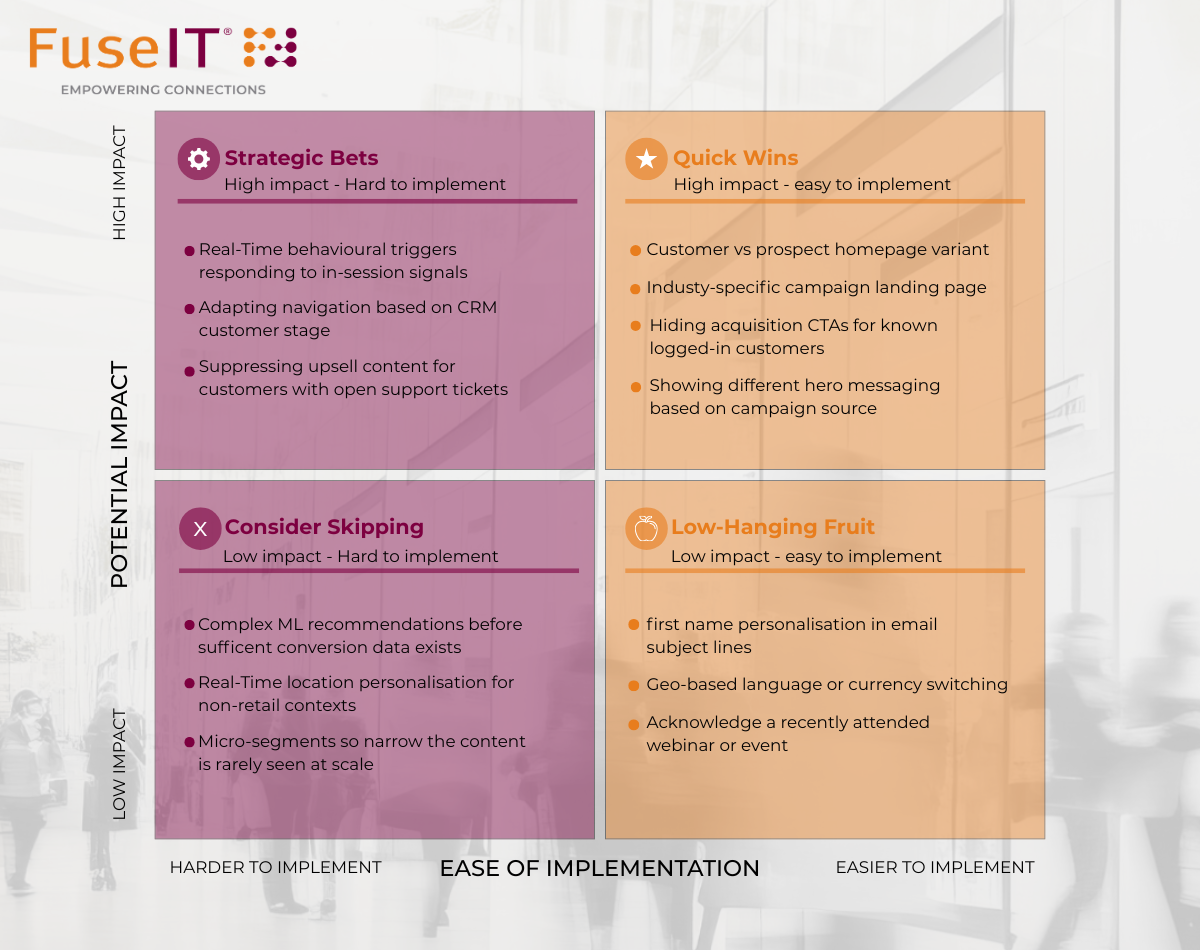
If you are assessing where to begin, the most useful starting point is usually the highest-traffic moment in your customer journey where the same experience is shown to everyone regardless of context. That is typically your homepage, a product or services page, or a key conversion point like a pricing or contact page.
Choose one of those pages and ask what you already know about the people arriving there that you are not currently using. If you have CRM data that distinguishes customers from prospects, start there. If you have campaign data that tells you which industry or role a visitor is likely to come from, start there. The first personalization you deploy does not need to be sophisticated. It needs to be relevant, and it needs to be measurable.
From that starting point, build progressively. Add signals from the Understand phase as triggers. Expand the segments you personalize for as your confidence in the data grows. Test alternatives and retire what is not working. The goal is not to personalize everything immediately but to build a capability that improves continuously over time.
Engage is where the Connect and Understand work becomes visible to the customer. It is where data stops being an internal asset and starts becoming something that directly shapes the experience of the people you are trying to serve.
The best engagement doesn't feel like "personalization" it feels like good service.
When personalization is done well, it does not draw attention to itself. Visitors do not think about the signals you have read or the rules you have built. They simply feel like they have landed somewhere that understands them and is making it easy to move forward. That is the outcome worth building toward. Use what you know to:
Do that well, and personalization becomes invisible, it's just a good experience that feels right.
Do it poorly, and it feels manipulative, or annoying, and can damage trust.
The organizations that excel at engagement aren't the ones with the most sophisticated technology. They're the ones who understand that personalization is a tool in service of better customer experiences, not an end in itself.
Coming Next: In the final part of this series, we will explore the Guide pillar in depth, looking at how to create clarity and momentum through complex, multi-step journeys where the stakes are highest and the room for confusion is greatest.
Questions? Connect with us on LinkedIn or schedule a conversation to discuss your personalization strategy.
Has this triggered any questions, and want to keep the conversation flowing? We'd love to talk.



Connecting systems and people since 1992.
A New Zealand–founded global tech company.


By clicking 'Accept all', you agree to the storing of cookies on your device to enhance site navigation, analyze site usage, and assist in our marketing efforts. View our Privacy Policy for more information.
