

This is part 3 in our forward-looking series on the future of revenue technology. In this series we explore the shifts already underway: the pressure on today's data stacks and closing the gap between signal and action, aligning sales and marketing around a shared source of truth, and bringing buyers and sellers into the same space.
(This article was origonally post on our linkedin here)
Every customer journey is actually two journeys happening at the same time.
There is the journey the organisation thinks is happening. The pipeline stages, the onboarding checklist, the renewal schedule. And there is the journey the customer is actually experiencing. In most organisations, these two journeys rarely align as closely as either side would like.
The gap between them is where deals slow down, onboarding stalls, and customers quietly disengage before anyone realises there is a problem.
Collaborative workspaces are a mechanism that closes that gap. Not only by giving organisations more visibility into their customers, but by creating a shared environment where both sides are genuinely navigating the same journey together.
These are dedicated spaces, typically hosted on a company's website or platform, where customers and organisations can work side by side toward a shared outcome. Whether that's completing a sale, resolving a service issue, or onboarding a new user, both parties can see the same information, take action in the same place, and move forward together in real time.
The traditional B2B sales model was built around a single point of contact. Find the champion, win the champion, let the champion sell internally. For a long time, this worked well enough.
It does not work as well anymore.
Modern buying decisions involve procurement, finance, security, legal, and sometimes executive leadership, each with different priorities, different questions, and different thresholds for moving forward. A single champion, no matter how enthusiastic, cannot adequately represent every concern across that group. Information gets filtered. Objections surface late. Deals that looked certain stall in the final stages because someone on the buying team nobody had spoken to directly raised a concern that nobody had anticipated.
Collaborative deal spaces change the dynamic by removing the dependency on a single conduit. When every person involved in the decision has direct access to the information that matters to them, security documentation for the IT team, commercial terms for procurement, outcome data for the business unit, the conversation becomes more honest and the process moves faster. Objections surface earlier, when there is still time to address them. The champion stops being a messenger and starts being an advocate in a deal where everyone is already informed.
This is not just a better buyer experience. It is a structurally more reliable way to close.
If the pre-sale experience is where deals are won, the handoff is where relationships are lost.
The sales-to-onboarding transition is statistically one of the highest-risk moments in any customer relationship. The reasons are consistent across industries. Everything the sales team learned during the deal cycle, the customer's priorities, the specific use case, the outcomes they are accountable for internally, rarely makes it intact to the people responsible for delivery. Customers who felt understood during the sales process suddenly feel like they are starting from scratch. The goodwill built over months of a sales cycle erodes in the first two weeks of onboarding.
Post-sale complexity compounds this. Onboarding involves multiple teams, multiple workstreams, and dependencies that customers cannot always see. From the customer's perspective, it often looks like silence punctuated by occasional check-ins. From the delivery team's perspective, things are moving. But nobody has shown the customer the map.
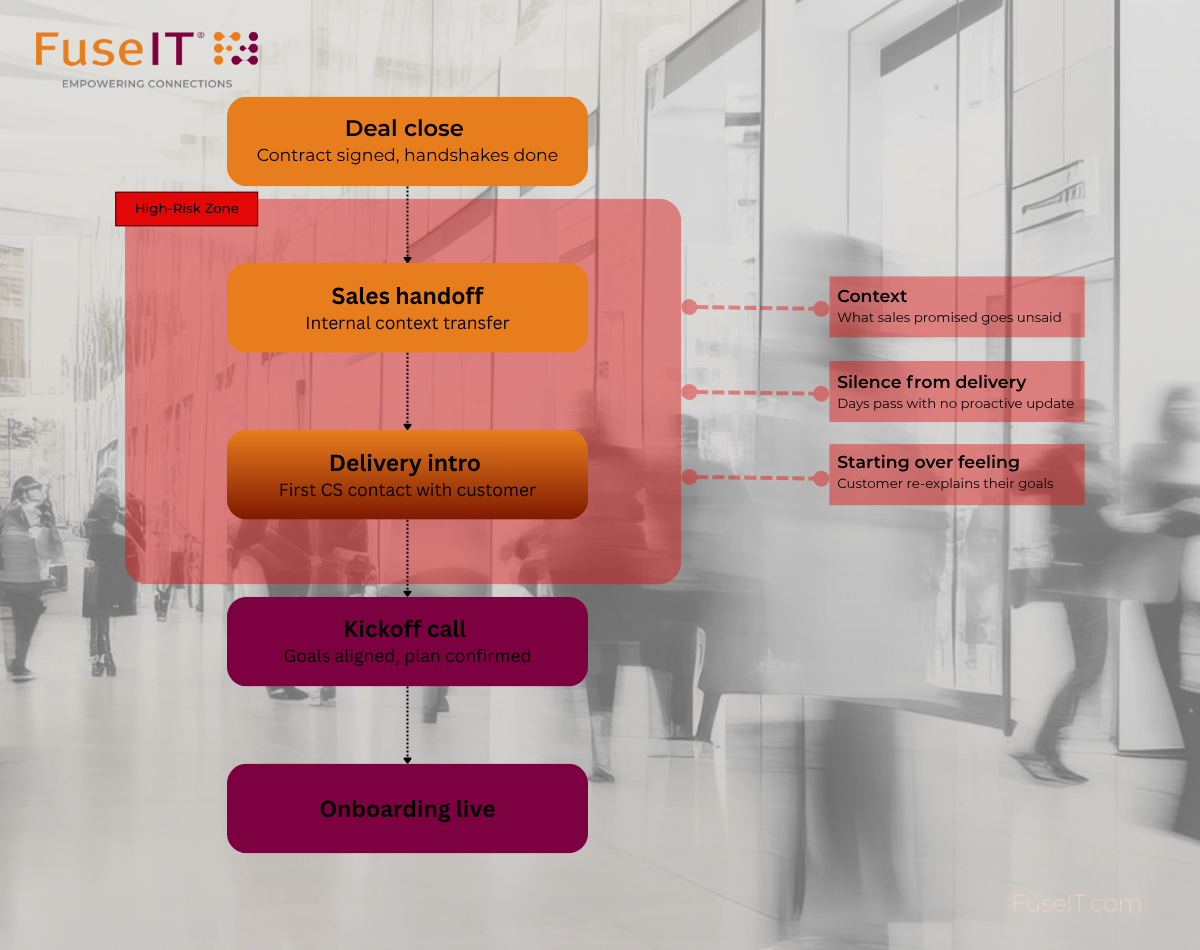
A shared workspace changes this. When the handoff happens inside an environment the customer has already been part of, the continuity is built in. The context does not need to be transferred because it was never siloed to begin with. And as onboarding progresses, both sides can see what is complete, what is in progress, and what comes next, without anyone needing to chase an update.
Both of these problems, the pre-sale complexity and the post-sale friction, are symptoms of the same structural issue. The journey belongs to the organisation, and the customer is a passenger.
The shift that collaborative workspaces enable is a genuine transfer of shared ownership. Progress becomes visible to both sides. The customer can see at any moment which steps are complete, which are in progress, who is responsible for each, and what comes next. The team on the other side can see the same thing. There is no need to chase updates because the update is always visible.
This matters beyond efficiency. When customers can see the journey clearly, they feel more confident in the relationship. When they feel more confident in the relationship, they are more likely to engage, more likely to advocate, and more likely to renew. Shared visibility is not just an operational improvement. It is a trust mechanism.
Look at your current customer journey, pre-sale and post-sale, and ask a single question at each stage: who can see where things stand right now?
If the honest answer is "mostly us, and only partially," that is the gap collaborative workspaces close.
“The organisations that will define customer experience over the next decade are not necessarily the ones with the most sophisticated technology. They are the ones who recognised that the journey belongs to the customer as much as it belongs to them, and built their systems accordingly.”
At FuseIT, this is exactly what we help organisations do. We work with revenue teams to design and implement the shared environments that bring buyers and sellers onto the same page, from first conversation through to successful delivery and renewal.
If any part of this series resonated with where your organisation is right now, we would love to talk. Whether you are rethinking your data stack, trying to close the gap between sales and marketing, or exploring what a collaborative customer experience could look like for your business, the conversation starts the same way: reach out to the FuseIT team and let us know where the friction is.
This is the final article in our RevTech series. If you missed the earlier parts, start with Part 1: The Data Stack Problem, or read Part 2: Creating Alignment: Unifying Sales and Marketing.
Has this triggered any questions, and want to keep the conversation flowing? We'd love to talk.




Connecting systems and people since 1992.
A New Zealand–founded global tech company.


By clicking 'Accept all', you agree to the storing of cookies on your device to enhance site navigation, analyze site usage, and assist in our marketing efforts. View our Privacy Policy for more information.
