

This is Part 1 in our forward-looking series on the future of revenue technology. In this series we explore the shifts already underway: the pressure on today's data stacks, the rise of collaborative sales environments, and the structural changes coming from AI and privacy. - This article was orginally posted on our LinkedIn here.
In This Series
For the past ten years, revenue technology followed a simple philosophy: capture everything. More tools, more data, more touchpoints, more signals. Marketing automation platforms, product analytics, website tracking, data enrichment tools, intent platforms, conversation intelligence, customer success software. Every new category promised greater visibility into the customer journey, and to a significant extent, it delivered.
Organizations now have more behavioural data than at any point in history. Website visits, email engagement, product usage, campaign performance, pipeline velocity, customer health scores. The information is there. The problem is that most organizations are data rich and insight poor.
The issue is not a lack of intelligence or analytical talent. It is structural. The stack itself became too complex. Signals are scattered across systems. Insights take time to assemble. And by the time action happens, the moment of opportunity has often already passed.
The last decade optimized for data collection. The next decade will optimize for decision speed.
The correction has already begun. Across the market, the rise of salesroom-style tools, collaborative deal spaces, and CRM-native engagement platforms signals something meaningful. These technologies are not about capturing more data. They are about reducing the distance between signal and action.
Instead of gathering information in one system, analyzing it in another, and executing in a third, the new generation of revenue tools is focused on collapsing those layers. And this is where the CRM begins to change its role.
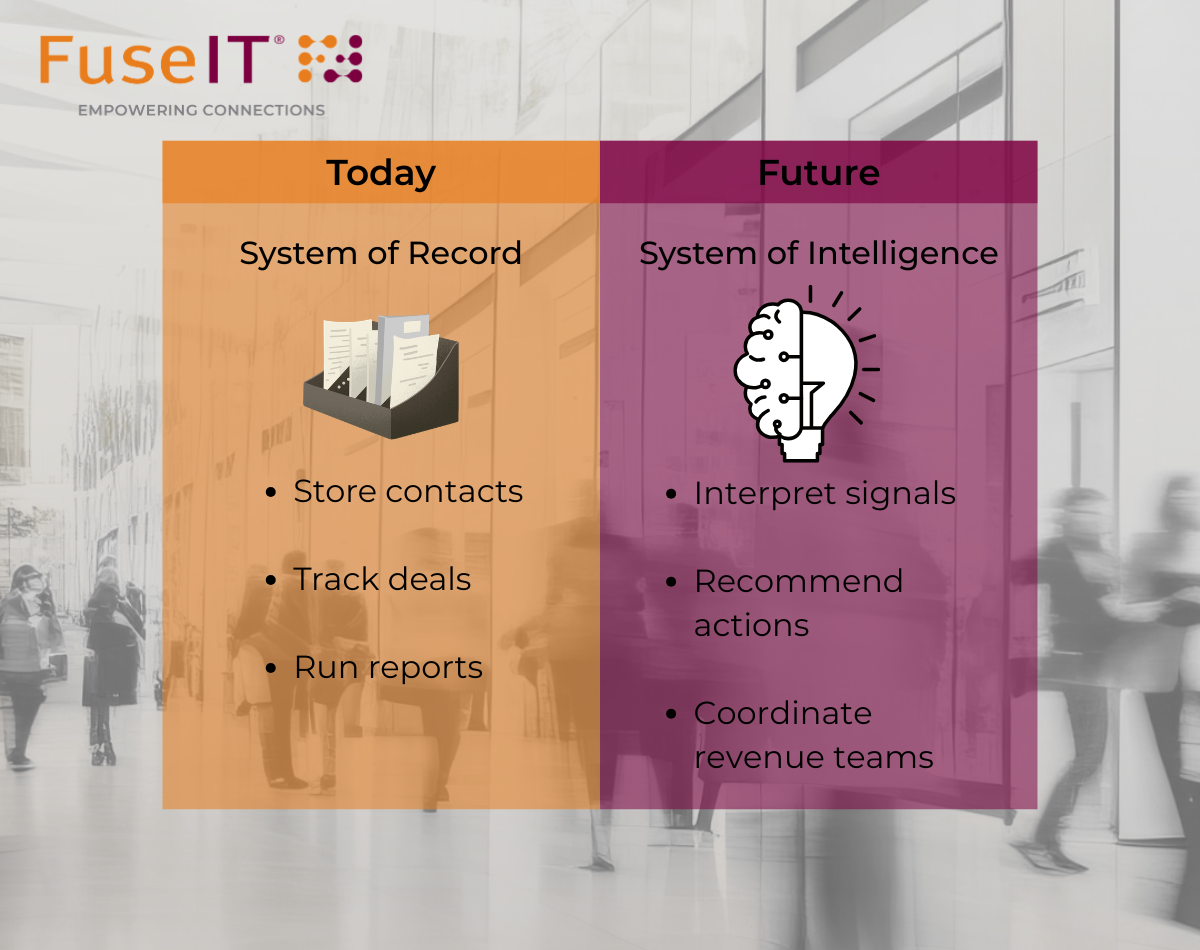
For most organizations today, the CRM functions like a sophisticated filing system. Teams put information in, pull reports out, and the real thinking happens somewhere else. But the next phase of revenue technology pushes the CRM toward something fundamentally different. Rather than a system of record, it becomes a system of intelligence, where insight, decision, and action happen in the same moment.
Artificial intelligence will accelerate this shift, though perhaps not in the way most people expect. The prevailing narrative is that AI will replace revenue teams. That is not where the real impact lies.
The true value of AI in a revenue context is that it removes the interpretation layer between behavioural signals and next actions. Today, a sales rep reviews a behavioural timeline and constructs a mental model from the evidence in front of them. A prospect visited the pricing page three times. They read a case study. They compared plans. From those signals, the rep forms a judgement about intent and decides what to do next.
AI compresses that entire process. Rather than interpreting signals manually, the rep receives a clear, evidence-based recommendation: this person is showing buying intent, here is what they have been researching, and now is the right time to reach out. The goal is not to remove human judgement from the equation. The goal is to make the right action obvious faster.
When that capability operates consistently across an organization, the entire revenue motion accelerates.
A second structural shift is happening in parallel, and it will matter more to some organizations than they currently realize.
As third-party cookies disappear and privacy regulations continue to tighten, businesses are losing access to many of the tracking mechanisms they have relied on for the past decade. The organizations that will gain a significant and durable advantage are those that can reliably recognize their own customers and prospects, without depending on third-party infrastructure to do it.
This means building genuine first-party identity resolution: knowing who is on your website, connecting behaviour to CRM identities, stitching activity across devices and sessions, and maintaining a clean, persistent customer record over time. These capabilities are not trivial to build, and once built, they are extremely difficult for competitors to replicate quickly.
Identity is no longer just a technical feature. For businesses that invest in it now, it becomes a strategic moat.
The final emerging trend is perhaps the most visible to anyone working in a deal cycle right now: the boundary between internal seller tools and external buyer-facing experiences is starting to blur.
Historically, sellers worked inside one environment, the CRM, internal dashboards, and productivity tools, while buyers interacted through another entirely, email threads, attached documents, and static web pages. The two worlds rarely met in a shared space.
Collaborative workspaces are beginning to change that dynamic. The concept behind modern deal rooms and guided buying environments is straightforward: buyers and sellers should be able to see the same information, track the same milestones, and communicate in context rather than across scattered email chains. Both sides navigate the deal inside a shared operating environment.
This is still early. But it is a strong signal of where revenue technology is heading. The future salesroom will not look like a document repository. It will look like a collaborative workspace where buyer and seller actively move through the journey together.
The first era of revenue technology was defined by the ambition to capture every possible signal. The era now emerging is defined by something harder and more valuable: the ability to act on those signals faster, more intelligently, and with greater alignment between the people responsible for driving growth.
But even the best data infrastructure and AI-powered intelligence will not create results if sales and marketing continue to operate in parallel rather than in partnership. That is the challenge we explore in the next article.
Part 2 Coming Soon: Creating Alignment - Unifying Sales and Marketing.
Has this triggered any questions, and want to keep the conversation flowing? We'd love to talk.




Connecting systems and people since 1992.
A New Zealand–founded global tech company.


By clicking 'Accept all', you agree to the storing of cookies on your device to enhance site navigation, analyze site usage, and assist in our marketing efforts. View our Privacy Policy for more information.
