

.png)
This is Part 2 in our forward-looking series on the future of revenue technology. In this series we explore the shifts already underway: the pressure on today's data stacks, the rise of collaborative sales environments, and the structural changes coming from AI and privacy. (Originally published on our LinkedIn here)
In This Series
Why Your Teams Are Misaligned (And It Is Not a People Problem)
Marketing, sales, customer success, finance. Every team has its own goals, its own metrics, and its own tools. On paper, this makes sense. In practice, it creates friction, poor handoffs, and ultimately a customer experience that suffers for it.
Revenue Operations was meant to fix this. RevOps promised to unite all revenue-contributing teams under a common operating model with shared goals, shared data, and shared accountability. The irony is that most RevOps teams spend the majority of their time managing the technical complexity that prevents alignment, rather than driving the strategic outcomes that alignment enables. They were hired to be architects. They spend their days as plumbers.
The Real Problem Is Data Visibility
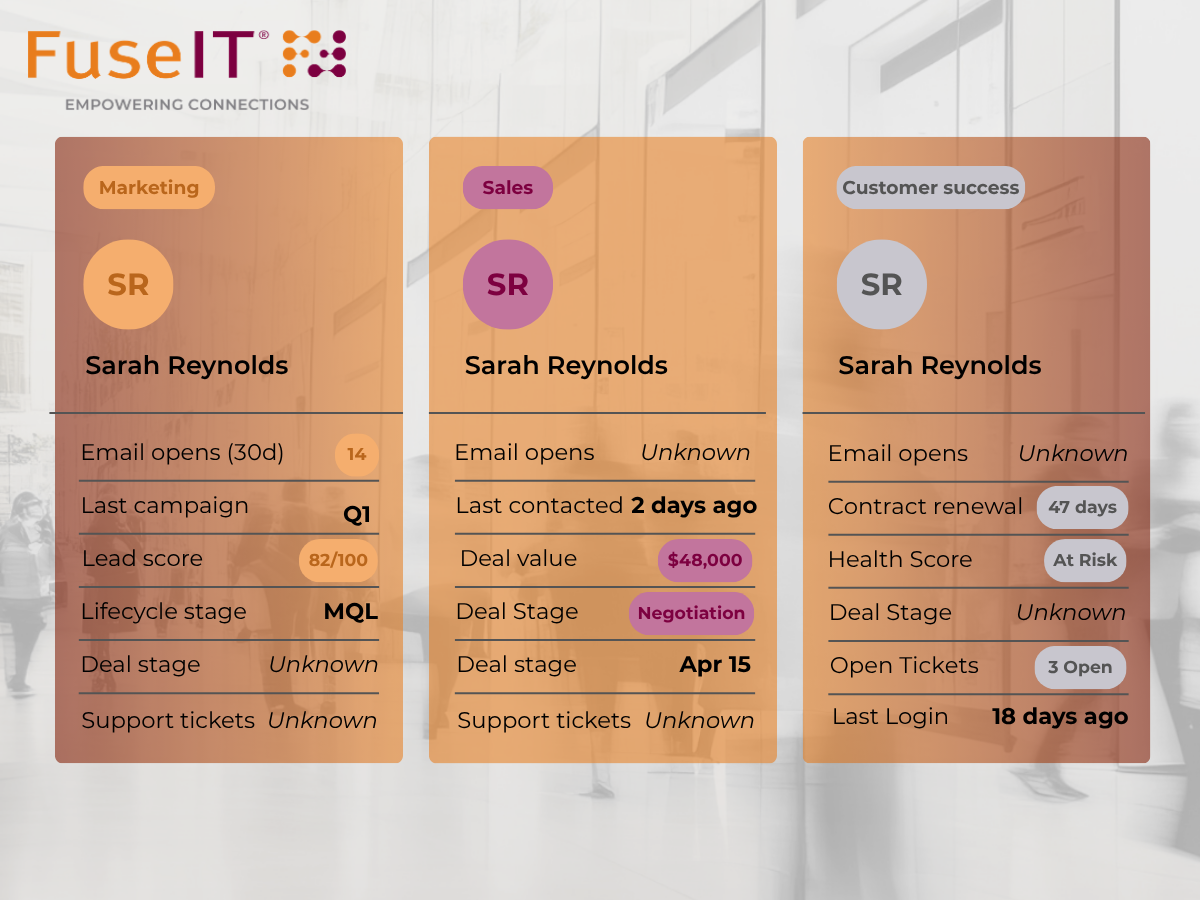
The alignment problem is, at its core, a data visibility problem. Marketing sees one version of the customer. Sales sees another. Customer success sees a third. When teams operate from different information, they make decisions that look rational individually but are incoherent collectively.
Marketing sends nurture emails to contacts that sales is actively closing. Customer success discovers churn risk that behavioural data flagged weeks ago, but that signal was never surfaced to the people who could act on it. Everyone is working hard. Nobody is working together.
Customer Data Platforms promised to solve this. Instead, they added more complexity. Data still has to travel to reach the teams who need it, and somewhere along the way it loses fidelity, or arrives too late to matter.
The Hidden Cost of Fragmented Data
There is a tax that most organisations never put a number on: the time RevOps spends extracting data from multiple systems and assembling it into a picture that any one of those systems should have been able to show automatically. It is invisible, habitual, and expensive.
Beyond efficiency, there is a trust problem. When different teams see different numbers, the debate stops being analytical and starts being political. Which system is right? Whose data do we act on? These conversations are symptoms of a structural failure, and they are entirely avoidable.
The speed dimension matters too. When behavioural signals flow directly into a single system in real time, the window between a customer showing high intent and a sales rep acting on it collapses from days to minutes. That is not just an efficiency gain. It is a competitive one.
CRM-Native Is an Organisational Decision, Not a Technical One
The answer is not a better integration. It is a better architecture. When your CRM becomes the operational model for the business, with applications built on top of it rather than alongside it, something important shifts. Team members stop switching between tools. They stop reconciling different versions of the truth. There is only one number, and it is the same number everyone sees.
Salesforce, at its best, is not just a system of record. It is a platform on which an entire go-to-market operation can be built and run. When that happens, the CRM stops being something teams log into and becomes the environment in which they work. The reporting debate disappears. The handoff gaps close. The data does not need to travel because it is already there.
CRM-native architecture is often framed as a technology decision. It is not. It is a decision about how you want your organisation to operate. It says that customer truth lives in one place, every team sees the same reality, and the systems shaping customer experiences both draw from and contribute to that single source.
Sophistication Is Not the Same Thing as Complexity
The organisations that will win the next decade of customer experience are not the ones with the most sophisticated stack. They are the ones who figured out that sophistication and complexity are not the same thing, and built accordingly.
The goal was never more tools. It was always better alignment. And alignment, it turns out, starts with everyone looking at the same thing.
What Comes Next?
Even with alignment in place across internal teams, the next frontier is the experience you create for the buyer themselves. The most forward-thinking revenue organisations are beginning to blur the line between internal seller tools and external buyer-facing environments, bringing both sides into a shared space where deals move faster and relationships deepen.
That is the challenge we explore in the next article.
Part 3 Coming Soon: The Salesroom Era: Why Working Directly With Customers Will Win.
Has this triggered any questions, and want to keep the conversation flowing? We'd love to talk.




Connecting systems and people since 1992.
A New Zealand–founded global tech company.


By clicking 'Accept all', you agree to the storing of cookies on your device to enhance site navigation, analyze site usage, and assist in our marketing efforts. View our Privacy Policy for more information.
